
How did we proceed?
HTM's models are not theory alone: whenever a quantity can be measured, we measure it. This page publishes our measurement campaign on the stretched fabrics of dedicated rooms (acoustically transparent screens, absorber frame facings, stretched walls), the full protocol, and its limits.
Goal
Quantify the insertion loss of four fabrics commonly used in private cinema rooms: how many decibels each textile removes from the signal passing through it, frequency by frequency, and depending on the sound's angle of incidence. A fabric sits in front of what matters most (the speakers behind a screen, the mineral wool of a frame, a diffuser): its real influence deserves better than intuition.
The four fabrics tested
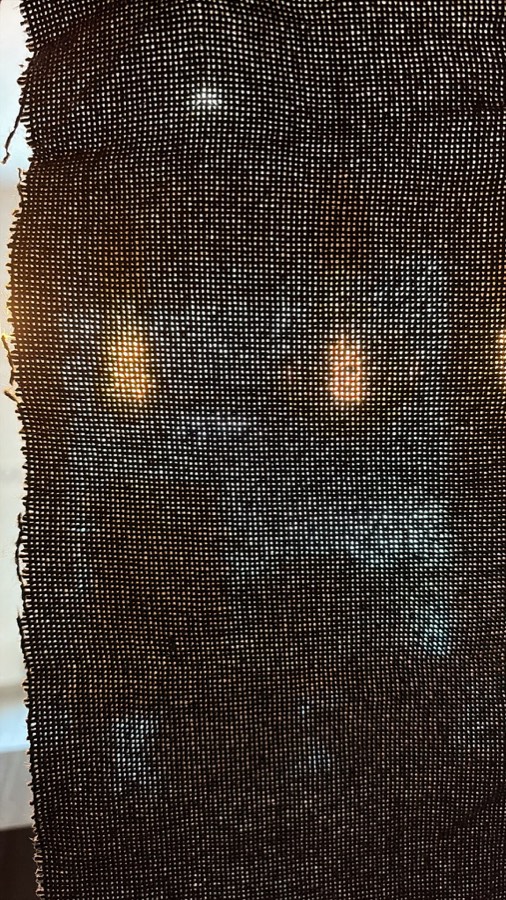
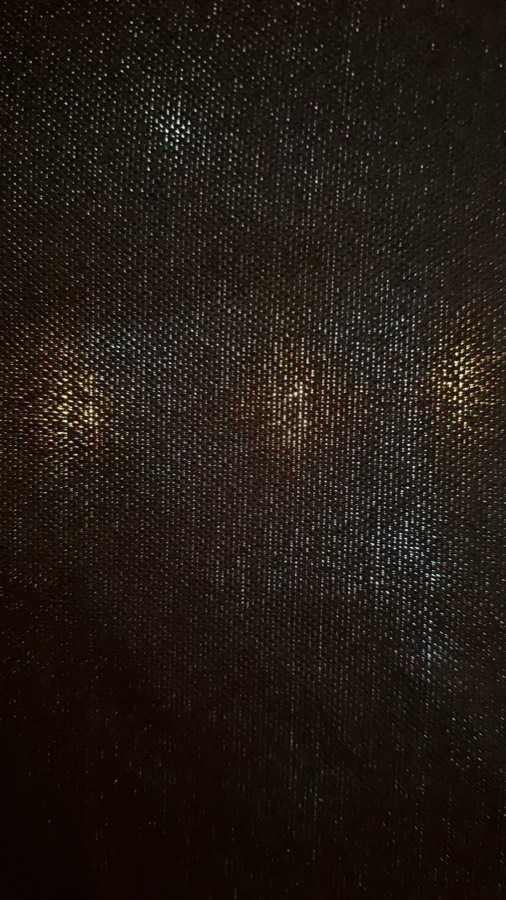
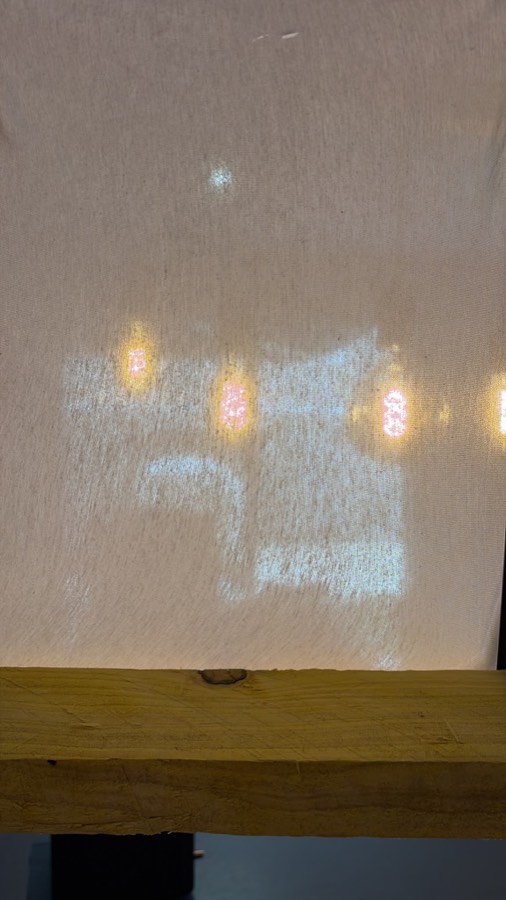
Four references representative of what actually gets installed, from the most technical to the most common. The samples are photographed against the light: the weave you see is what lets the sound through, or not.
Measurement protocol
Measurements were taken with REW (Room EQ Wizard) V5.31.3 and a calibrated measurement microphone, each configuration compared against the same fabric-free reference.
Free-field reference
Acquisition of a reference impulse response without fabric, serving as the baseline for the insertion-loss calculation. All measurements share the same source and microphone positions.
Fabric setup
Each textile is stretched on a frame (or laid loose for the untensioned case), placed between the source and the microphone at the desired angle of incidence.
Measurement at 0° (normal incidence)
Response recorded with the fabric perpendicular to the source-microphone axis: the case of an acoustically transparent screen facing the speakers.
Measurement at 45° (oblique incidence)
The rig is rotated to evaluate the influence of the angle of incidence on transmission: the case of surrounds, lateral reflections and frame facings seen at an angle.
Data processing
Insertion loss computed by subtracting the reference, point by point on a strictly identical frequency grid (96 points per octave), then smoothed to 1/3 octave for comparative reading.

What the measurements give
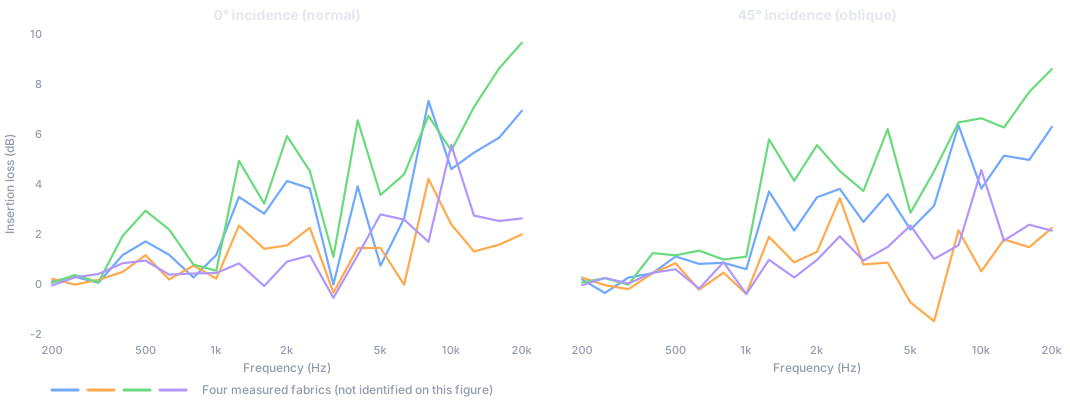
The four curves below are drawn from REW's raw exports, untouched: measured insertion loss relative to free field, at both angles of incidence. A value close to 0 dB means an acoustically transparent fabric; the higher the curve, the more the fabric muffles the treble.
What we can say here
The spread between the measured fabrics reaches several decibels in the treble: at that scale, choosing the textile is not a finishing detail, it is audible. Installation weighs in too, for one and the same material. The angle of incidence changes little (under 1 dB between 0° and 45° for most samples).
Knowing which reference behaves how, and which one to pick for an acoustically transparent screen or a frame facing, is the substance of the study itself: it is reserved for HTM Pro users, who get it applied straight to their own project.
The limits, and why we publish them
An honest measurement also states what it does not know. Three limits to keep in mind before quoting these figures:
Relative values
Insertion loss is computed as the difference from free field, under identical conditions. That is exactly what is needed to compare fabrics with each other; it is not a standardised laboratory measurement of absolute transmission.
Reliable above 200 Hz
The measurement takes place in a real room: below 200 Hz the room's reflections dominate, not the fabric. We therefore publish nothing below that frequency. Good news: a fabric's action happens precisely in the treble.
One sample per fabric
Each reference was measured on one sample, at two angles. The orders of magnitude and the gaps between fabrics are robust; the decimals would vary from one cut to another.
Fabric names are cited to identify the measured samples. Independent measurements, carried out by us: no partnership or commercial link with the manufacturers or distributors of these textiles.
Where to find the study?
The measured coefficients join HTM's acoustic database. They will power the following Pro features, where the data is applied to your own room rather than handed over as a raw table:
- Acoustically transparent screen: apply the chosen fabric's real insertion loss to the predicted response of speakers placed behind the screen, and suggest the matching EQ compensation.
- Frame and module facings: account for the fabric covering an absorber or diffuser when computing its real efficiency.
- Textile choice: guide the trade-off between visual finish and acoustic transparency, with measured figures to back it up.
The method will stay the same as on this page: measure first, model second, always publish the limits.
Discover HTM Pro